Age Verification
Kinetic Co. sells hard goods related to firearm-mounted equipment. You must be 21 years of age or older to enter this site.
Kinetic Co. sells hard goods related to firearm-mounted equipment. You must be 21 years of age or older to enter this site.
Why fast follow-up capability with 40mm less-lethal systems is a force-continuum imperative — and why reload time is a life-safety variable, not a footnote.
National Institute of Justice five-year analysis — share of encounters resolved on the officer's first application of force, by tool:
CEW / TASER
Chemical Agents
Impact Weapons
Compliance Holds
Impact munitions — the category 40mm rounds fall into — ended confrontations on the first application less than half the time. Injury rates to officers and subjects rise with every additional round. And separate DOJ-funded research found that when officers must resort to standard firearms, close to half of the citizens struck do not survive. The seconds between round one and round two are where outcomes are decided.
Less-lethal 40mm impact munitions exist to close a critical gap in the use-of-force continuum: the space between verbal de-escalation and deadly force. But a launcher is only as effective as an officer's ability to keep it in the fight.
When a first round fails to gain compliance — as national use-of-force data show happens routinely — the officer's next decision is made in seconds, under stress, often with a threat actively closing distance. If a fast, reliable follow-up round is not immediately available, the practical result is that officers are pushed toward the next tool on their belt, which is frequently the sidearm.
This paper examines the operational and life-safety case for prioritizing follow-up shot speed — reload mechanics, munition accessibility, and launcher handling — as a core design and training requirement for 40mm less-lethal programs, not an afterthought to it.
The Reload Gap
Why Fast Follow-Up Capability with 40mm Less-Lethal Systems Is a Force-Continuum Imperative
A white paper on equipment, training, and officer decision-making under time pressure. Trevor Benson, Kinetic Co. (KNTX) · August 9, 2026.
Sources: National Institute of Justice, “Less Lethal Weapon Effectiveness, Use of Force, and Suspect & Officer Injuries: A Five-Year Analysis”; NIJ, “Impact Munitions Data Base of Use and Effects”; Rampart Corp, “De-Escalating on the Front Line with 40mm Projectile Launchers”; U.S. patent literature on less-lethal speed-loading assemblies. Share this page: www.kntx.org/resources.html
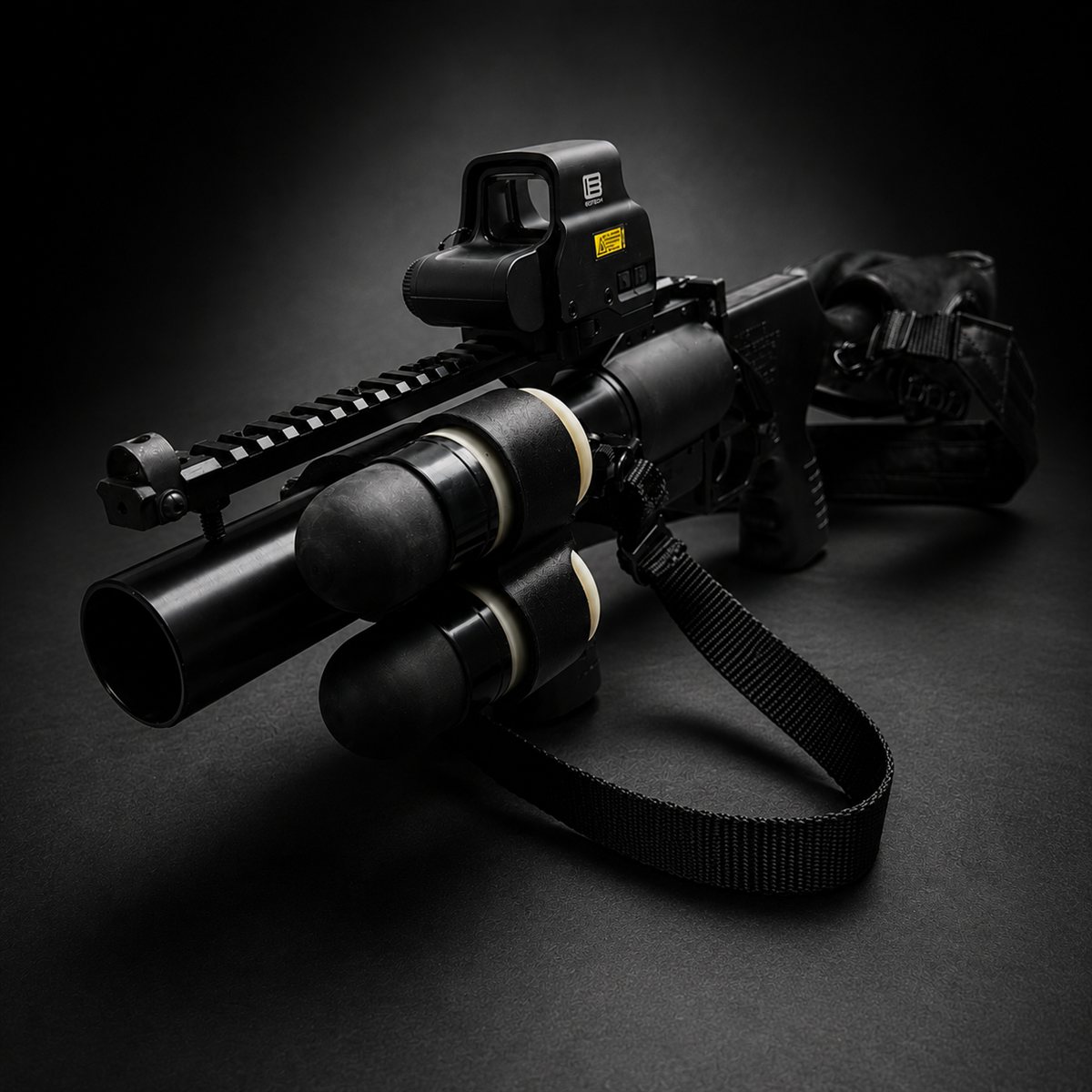
Kinetic Co. built the Double Shell Caddy to answer the exact problem this paper describes: two rounds held in a fixed, known, indexed position — retained by stainless steel ball detents through movement and struggle, yet drawn in a single motion under stress. Nothing to unsnap, unzip, or dig for.
Every second removed from a reload is a second the less-lethal window stays open.